
Victoria’s 2025-26 mid-year financial report was released on Friday and showed the state’s net debt increased by $10 billion in six months, to $160.9 billion:
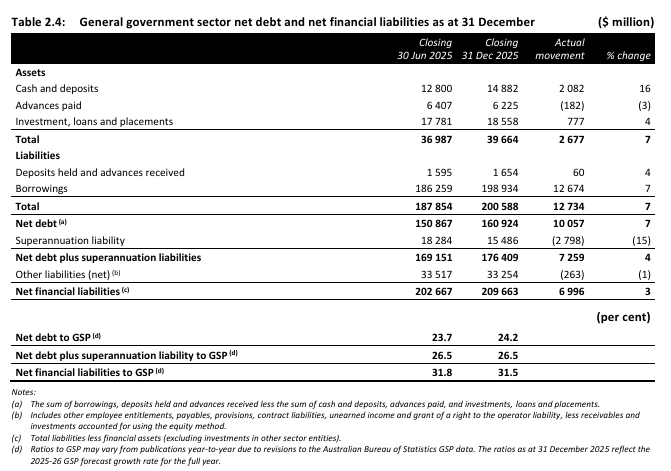
Net debt as a share of the state economy rose to 24.2 percent from 23.7 percent in six months.
Interest rates are also rising. In the first half of the year, $3.8 billion was spent on interest, up $522 million from the same period last year.
Advertisement
Interest payments are on track to reach $1 million per hour.
Tax revenue increased by $2.1 billion compared to the same period last year, due to:
- Stamp duty increased by $923 million, driven by higher settlement volumes and transaction values.
- Introduction of the Emergency Services Levy.
- Broader payrolls and economic activity contribute to tax growth.
Advertisement
Despite this growth, income growth has not kept pace with the combined pressures of wages, interest, and infrastructure spending.
In particular, employee expenses increased by $1 billion year over year, reflecting new enterprise bargaining agreements and higher staffing levels.
Employee spending rose to $23 billion in the first six months, already 52% of the full-year budget estimate, signaling that the annual wage bill will again exceed forecasts.
Advertisement
This is a long-term pattern in which wage growth has been structurally higher than government forecasts.
The Parliamentary Budget Office found that while Labor governments have forecast annual wage growth of 3.1–5.2%, actual growth since 2014 has been 5.7–8.7%.
Treasurer Symes says the economy is strong and the government is providing “real relief” to households.
Advertisement
“Our economy is strong and we are on track to deliver a budget surplus,” Sam said. “We know there are Victorians who are struggling which is why we are providing real relief to save people time and money”.
Opposition Leader Jess Wilson argues that interest payments – soon to reach $1 million an hour – are crowding out basic services such as road maintenance, school funding, and police station operations.
“With Labour’s record debt interest payments soon to hit $1 million an hour, is it any wonder why we can’t fill potholes, properly fund our schools or keep our local police stations open?” he said.
Advertisement
With 2026 an election year, Victoria’s upcoming May budget is being shaped by two opposing forces: political pressure to provide cost-of-living relief in an election year and economic pressure to avoid worsening inflation and protect the state’s AA credit rating.
The government has indicated that a key feature of the May 4 budget will be cost of living support. However, economists and rating agencies warn that:
- Additional spending can increase inflation, especially when the economy has limited capacity.
- Any new relief measures must be matched by savings or revenue increases to prevent the state’s financial situation from deteriorating further.
- The RBA has already said that government spending contributed to the recent rise in inflation, raising rates to 3.85% from 3.6%.
Advertisement
Independent economist Saul Eslick argues that pre-election incentives could take priority over budget repair, increasing the risk of the state drifting further from a sustainable fiscal path.
“This is not the same as returning Victoria to a sustainable position … Victoria has implemented some revenue growth, but they need to do more or reduce more operating or capital expenditure,” Eslake said.
“When the government spends money at a time when the economy’s capacity is limited and its speed limit is high, it increases inflation. Any decision by the Victorian government to give people cost-of-living relief is likely to happen. [RBA] It is likely to lead to higher interest rates.”
Advertisement
Global rating agencies are also watching Victoria closely.
“Expenditure pressures ahead of elections remain a clear downside risk if savings or offsets are not met”said S&P analyst Rebecca Hrvatin. “Victoria has a rich, diversified economy and strong market access – these are strengths – but spending decisions that materially weaken operating margins could pressure the rating”.
Fitch analyst Paul Norris also warned that election spending had increased. “The rating could potentially weigh on, especially amid ongoing global economic uncertainty”.
The last thing Victorians need is for the government to add to the debt pile through “cost of living” measures while prompting the RBA to raise rates.
Advertisement