
Shortly after the outbreak of war in the Middle East and relatively reduced traffic through the Strait of Hormuz, the flow of global jet fuel exports was quickly cut in half, as the flow from the Persian Gulf ceased and China’s near ban on fuel exports took effect.
Now that the conflict has been going on for almost two months, the impact of reduced exports is beginning to show dramatically in the total amount of jet fuel/kerosene on water that is delivered to ports around the world.
This time last year, ports around the world averaged 4,300 kilotons of jet fuel/kerosene.
Advertisement
Today, with about 2,100 kilotons of these fuels on the water for delivery, about half is.
Amid this challenging outlook, airlines in Asia in particular are cutting flights and warning of further disruptions to come.
Advertisement
According to some estimates, the most proportionate impact has been felt by AirAsia (including its subsidiaries), which has pulled around 10% of its total flight capacity due to supply issues and high costs.
Meanwhile, International Energy Agency Executive Director Fateh Birol has warned that the effects of the crisis will gradually spread around the world, noting that the flow of energy through the Strait of Hormuz is blocked: “The biggest energy crisis we’ve ever faced”.
In a recent interview with The Associated Press, he said that Europe “Maybe six weeks or more of jet fuel left” And that “If we are not able to open the Strait of Hormuz … I can tell you that we will soon hear reports that some flights from City A to City B may be canceled as a result of jet fuel shortages.”
Advertisement
A complex picture
The world market for jet fuel is very difficult for countries that are importers.
Globally, somewhere between 70% and 75% of jet fuel is produced for domestic use, leaving only 25% to 30% of the fuel to be exported to countries that need it.
Advertisement
Although Asia was the first to suffer due to its dependence on flows through the Strait of Hormuz, Asia generally did not experience the greatest decline in global jet fuel exports.
According to United Nations Energy Statistics Handbook data for 2023, the five largest net importers of jet fuel are:
- Great Britain
- Germany
- Australia
- France
- Mexico
Advertisement
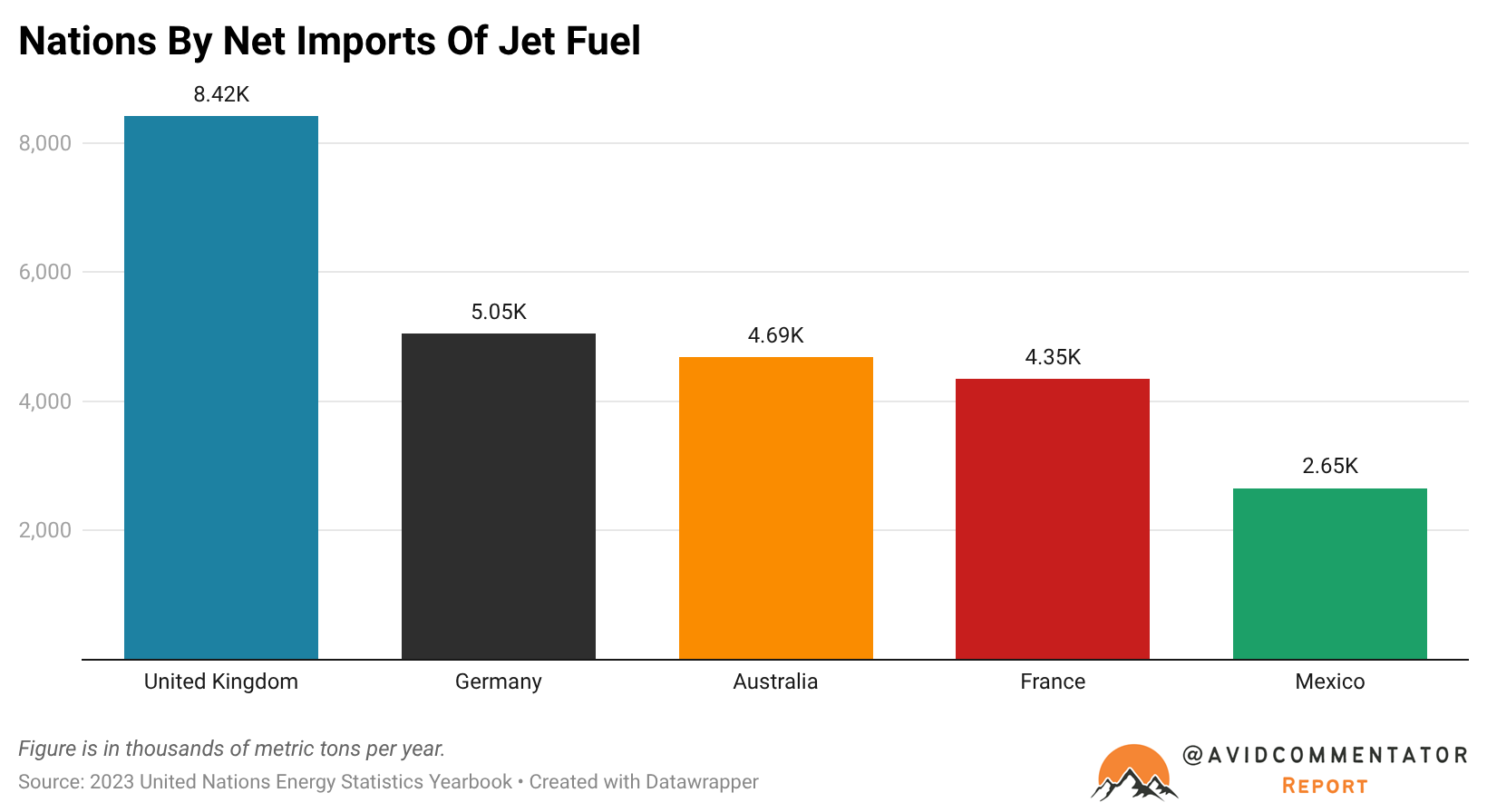
These are the nations that, over the long-term timeline, will need to compete for a dramatically smaller piece of the aviation fuel pie, as it is set to shrink by more than half.
While nations like Australia have the financial power to overtake net jet fuel importing developing countries, if the crisis persists long term, bidding wars against other wealthy large net importers such as Germany, France, Britain and Switzerland are going to be a very different story.
Advertisement
At this stage the possibility of disruptions to import flows and significant reductions in flights increases significantly as the financial power of the developed world is used to secure cargo against each other so that air transit and trade can operate at normal levels.
As IEA Executive Director Birol noted, Europe is not yet at a crisis point, but it will get there in the coming weeks and months, and then the rush for jet fuel will become much more difficult.