
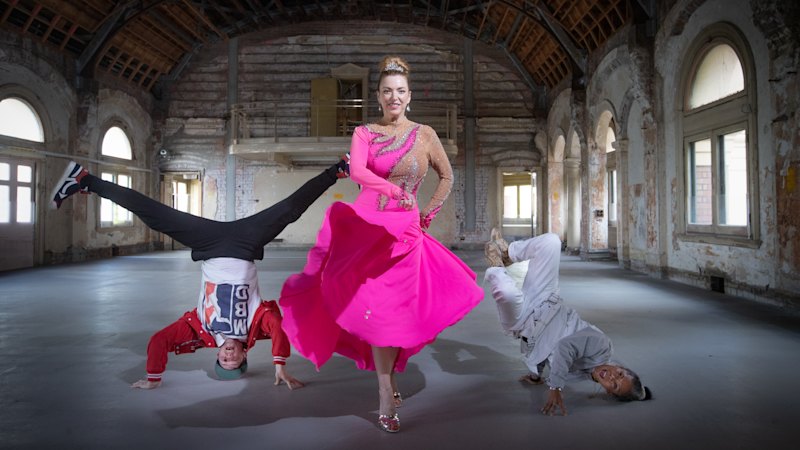

For the first time in decades, the Flinders Street Station ballroom will echo with the noise of stomping, shuffling and gliding feet as the Rising Arts Festival launches a season of public dance classes in the grand and fabled space above Platform 1.
“We’ve put a lot of focus on dance and music throughout the program this year,” says festival artistic director Hannah Fox. “And as part of that, we’re looking at Flinders Street Ballroom’s history as an amazing community dance space.”
Designed in 1899 and opened in 1910, Flinders Street Station housed a range of facilities for the staff of the Victorian Railway Institute in a warren of rooms over four levels (including the terrace, which housed the caretaker’s cottage).
There was a classroom for new Australians, a children’s nursery (for women railway workers and shoppers coming to town by train), and classrooms where workers could take lessons to move up the ranks.
The real gold, though, was on the third floor, which housed a gymnasium, a library, a billiards room and a vaulted-ceilinged ballroom, a multi-purpose space that in its heyday was used for lectures, meetings and, of course, dance classes.
“It was quite a utopian model,” says Fox of the VRI campus at the city’s southern gateway. “It was much more than a train station.”
But by the 1960s the ballroom had begun to fall into disrepair, and in 1985—because of leaks, crumbling plaster, falling pigeon tins, and rotting parquetry floors—it was deemed a hazard and closed to the public. For decades thereafter, the space remained only in memories and legends.
“I was always fascinated by it,” says Fox, who first tried using the space around 2009, when she was music curator for the Melbourne International Arts Festival (a precursor to Rising). But while some sound and light projects were commissioned there, it wasn’t until the station underwent a $100 million renovation in 2018 that it became open to the public.
The first use of the third floor rising was for an installation by Patricia Piccinini. A miracle that keeps repeating itself. In its first (and COVID-interrupting) season in 2021. He has since used it for Rone. time (2022), with a local theme Shadow Spirit (2023), and last year Swingers – The Art of Mini Golf.
For the first time this year, the space will revisit its origins with dance classes ranging from ballroom to breaking to boot scooting and beyond (including our very own Melbourne Shuffle), for $29 per session.
The season is part of a wider program of dance that encourages, Fox says, “how popular dance is in Australian culture. Not only do we love to dance as people, we’re really good at it.”
“There are millions of people dancing to TikTok, either in town squares or in their bedrooms, and with the rise of rave culture, dancing has become part of how we go out and gather. So we wanted to tell that story through the program – and Land of 1000 Dances There is one of them in the ballroom.
This is Fox’s first year as solo artistic director, as Gideon Obarzanek, founder of Chunky Move and its co-director since Rising’s launch in 2020, now heads the Australian Dance Biennale which will be presented as part of Rising for the first time this year.
While the Biennale will bring some of the world’s best dancers to Melbourne, classes in the ballroom and a free mass dance class held in Federation Square by New Zealand-based The Royal Family Dance Crew are designed with excitement rather than skill in mind.
“I think we all approach a dance class with some level of trepidation, but you get absorbed in the movement very quickly, and the embarrassment goes away quickly,” says Fox, who admits she once spent six months on a 90-second routine “that I still messed up”.
As for the ballroom and the rest of the rooms on the upper levels of Flinders Street station, they are now preserved and functional but still far from their original glory (for example the ceiling of the ballroom is exposed wood and steel rather than the decorative plaster of old).
“It’s going to take a huge investment” to fully restore it, Fox admits. “But I think this kind of temporary transitional use for intimate events and exhibitions is a really good way to keep it active and keep telling the story of this building.”